We work alongside our clients' factories, thinking together and growing together,
as a trusted partner in industry who always walks hand in hand with the field.
The Smart HACCP Management System utilizes IoT technology in food manufacturing plants to
automatically record, manage, verify, and store Critical Control Point (CCP) monitoring data
in real time, preventing data falsification or tampering.
The system enables management of foreign material control, hygiene and process inspections,
CCP verification checks, pest control management, and calibration logs.
It also integrates washer systems, metal detectors, and temperature and humidity records
to provide alerts, traceability, and corrective actions for more efficient CCP management.
What is Smart HACCP?
A comprehensive real-time HACCP management system that digitalizes record logs using IoT technology
and automates monitoring of critical food safety control points and major processes,
encompassing data collection, management, and analysis.
Automation
Manual recording of temperature and time, handwritten detection logs
Systemized food safety management
with automated IoT-based monitoring
Data Exchange
Information delivered through handwritten records
Real-time data transmission
through automated monitoring tools
Intelligence
Reliance on individual operator judgment
Utilization of intelligent big data analytics
ICT Convergence
Verification of handwritten logbooks
Analysis of transmitted big data with automatic recording,
alerts, and corrective actions when standards are exceeded
Benefits of HACCP Implementation
A real-time integrated HACCP management system that digitalizes various log data using IoT (Internet of Things) technology and automates the monitoring of critical control points and key processes related to food hygiene,
comprehensively covering data collection, management, and analysis.
Benefits of Smart HACCP Implementation
HACCP Records
Digitalization of HACCP document management
Reduced workload and improved productivity
Decreased paper-based documentation
HACCP Monitoring
Real-time monitoring of CCP (Critical Control Points)
Immediate corrective action in case of hazards
Accurate data collection through sensors
Improved production standards
HACCP Audit
In the event of a workplace incident
Rapid response
Reduced audit time
Big Data Utilization
Big Data analysis of CCP hazard factors
Establishment of predictive food safety policies
<Benefits of Smart HACCP Implementation> ※ Reducing employees’ workload and lowering production costs
Key Considerations When Implementing Smart HACCP
01
Automated record management of Critical Control Points (CCP)
Whether a system is in place to automatically collect, store, review, and approve data in real time
02
Prevention of tampering and falsification of monitoring records
Whether arbitrary modification of data is prevented
Whether revision history can be verified when modification is unavoidable
03
Alert for deviation from critical limits
Whether warning and notification functions are provided when CCP critical limits are exceeded
Storage, retention, and retrieval of log records for CCP critical limit deviations
04
Response plan in case automated record management system cannot operate
Whether there is a response plan in case the automated system becomes inoperable
Establishment of a CCP monitoring emergency plan
HACCP Mobile Menu Configuration
Performance Registration
Production performance can be registered when a production order is issued from MES.
Process Inspection
Process results and good/defective quantities and defect types can be registered.
Incoming Inspection
Incoming inspection can be registered and viewed.
Work Order
Production work orders
Purchase Receiving
Products and materials purchased through purchase orders can be registered upon receipt.
Delivery Shipment
Products are shipped based on the shipment order registered in MES.
Inventory Inquiry
Inventory can be checked and registered.
HACCP Documents
HACCP-related inspection checklists can be registered.
Pest Control
Pest control inspection records can be registered.
Material Issue
Materials can be issued on a FIFO basis by scanning material barcodes.
Notices
Notices registered in MES can be viewed.
HACCP Management Documents
Complaint Management Log
Recall-Related Documents
General Hygiene Management and Process Inspection Checklist
Nonconformity Management Checklist
Supplier Inspection Checklist
Critical Control Point (CCP) Verification Checklist
Pest Control Checklist
Calibration Certificate
Raw and Subsidiary Material Incoming Inspection Log
In-house Training Log and Annual Training Plan
Foreign Material Management Checklist
Equipment History Card
Finished Product Shipment Management Records
Client Contact List
Sub-material Test Report
Health Certificate
Other Legal Documents (Business Registration Certificate, Business License Report, Building Register, Mandatory Hygiene Training Certificate, HACCP Team Leader Training Certificate, Factory Registration Certificate)
Disinfectant MSDS
Product Manufacturing Report
Pest Control MSDS Documents
Pest Control Disinfection Certificate
Pest Control Result Report
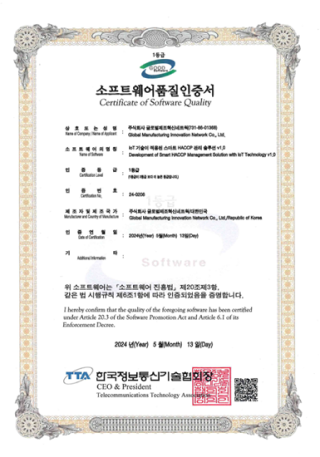
Quality certificate
GS Certificate
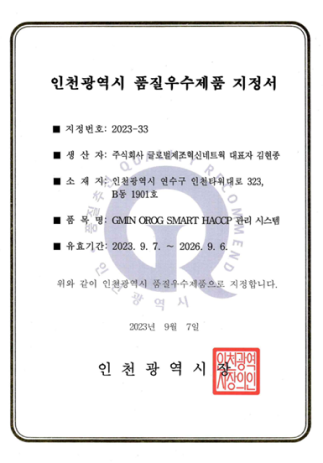
Incheon Metropolitan City Excellent Quality Product Designation Certificate